
04
Wed
November
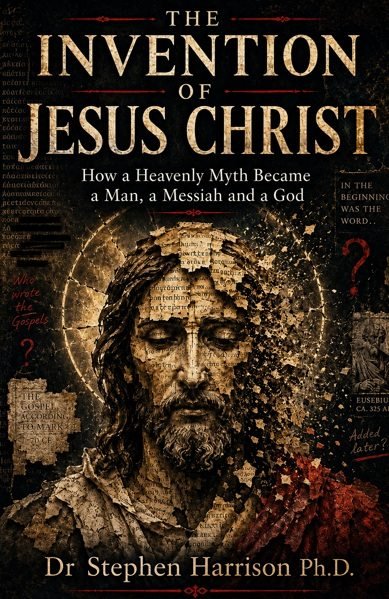
The Invention of Jesus Christ: How a Heavenly Myth Became a Man, a Messiah and a God
by Dr Stephen Harrison (Author)
$14.99
Was Jesus a historical figure or a myth transformed into a Messiah? This provocative book explores the origins of Christianity, questioning the Gospels, miracles and resurrection while examining how ancient beliefs evolved into one of the world's most influential religions.
Description
What if the story of Jesus did not begin with a man who became a god, but with a heavenly figure who was gradually turned into a man?
The Invention of Jesus Christ examines Christianity from the evidence outward rather than from faith backward.
Written in a direct, accessible and often sharply humorous style, the book asks questions that are rarely explored in ordinary churches or religious education. Why does Paul, the earliest surviving Christian writer, say so little about the earthly life of Jesus? Why do the Gospels contradict one another? Why do Matthew and Luke tell different birth stories? Why does the resurrection become more physical and detailed in later accounts? Who actually wrote the Gospels? Who chose the books of the Bible? What did Constantine really do? And where is the independent historical or physical evidence for the miraculous Jesus described by Christianity?
The book follows the development of Christ from revelation to biography, from biography to doctrine, and from doctrine to institutional power. It examines Paul, the Gospel writers, Jewish scripture, Greco-Roman religious culture, failed apocalyptic predictions, miracles, resurrection claims, the formation of the biblical canon, Constantine, textual alterations, relics and the changing teachings of the Church.
It does not depend on sensational claims that Christianity simply copied Mithras, that Constantine invented Jesus, or that the Council of Nicaea chose the Bible. Those stories are examined and rejected where the evidence does not support them.
Nor does the book claim that it can prove that no Jewish preacher called Jesus ever existed. A historical individual may have contributed to the tradition. The more important question is whether such a person provides evidence for the supernatural Jesus of the Gospels.
The argument of this book is that it does not.
An ordinary preacher does not prove a virgin birth, miracles, divine incarnation or resurrection any more than discovering a real boy called Harry would prove that Harry Potter was a wizard.
Who Is This Book For?
This book is written for curious readers rather than theologians.
It is especially for people who grew up hearing selected Bible stories but have never read the New Testament critically from beginning to end. It is for Christians willing to examine the foundations of what they were taught, former Christians trying to understand why they stopped believing, agnostics and atheists interested in the origins of Christianity, and anyone who has ever wondered why extraordinary religious claims are so often granted a standard of evidence that would be unacceptable anywhere else.
No specialist knowledge is required.
The language is deliberately clear and conversational. The scholarship is taken seriously, but the reader is not expected to have studied ancient Greek, theology or biblical criticism.
This is not a devotional book.
It is not an attack on individual Christians.
It is an investigation of the story itself.
If you have ever asked Who actually wrote the Gospels? Why should I trust them? Did Jesus really predict his return within his generation? Who decided which books became scripture? Where is the evidence for the resurrection? — this book was written for you.
The central question is simple:
What happens when we stop assuming that Christianity is true and ask what the surviving evidence actually shows?
Publication Year : 2026
ISBN : 979-8194069415
Reader Testimonials / Reviews :
Customer Review
Shar Guy
5 out of 5 starsA Distinctive Book in a Crowded and Long-Running Debate
Reviewed in the United States on August 29, 2026
Format: Kindle
A provocative but well-sourced contribution to a much older debate
I bought and read The Invention of Jesus Christ because the title caught my attention, but what stood out most was how clearly it brings together a large body of historical and biblical scholarship for a general reader.
The book covers Paul’s limited references to the earthly life of Jesus, the anonymous Gospels, contradictions between the birth and resurrection accounts, the development of Christology, Constantine, canon formation, textual changes and the difference between a possible historical preacher and the supernatural Christ of Christianity.
These are not unusual or proprietary subjects. They have been discussed for decades by scholars such as Bart Ehrman, John Dominic Crossan, Robert Price, Richard Carrier, Elaine Pagels, Mark Goodacre and Bruce Metzger, among many others, and the author provides a bibliography so readers can check the sources for themselves.
There are also several books built around very similar themes and even similar titles. Peter Cresswell published The Invention of Jesus: How the Church Rewrote the New Testament in 2013. Trevor Rice’s The Invention of Jesus, Henry Bugalho’s The Invention of Jesus: How a Galilean Preacher Became the Christ — and the Christ Became God follows another closely related line of inquiry. Chris Bone’s The Invention of the Christ: From Anonymous Greek Stories to the Savior of the World is yet another recent example.
That wider context matters. Books investigating how the historical Jesus tradition developed will naturally discuss Paul before the Gospels, Mark before Matthew and Luke, John later still, and eventually the canon, councils and imperial Church. Similar subject matter and chronology are therefore not surprising.
Harrison’s book has its own distinctive position. It is more sceptical than many mainstream historical-Jesus studies and repeatedly distinguishes between the possibility that an ordinary Jewish preacher may have existed and the much larger claim that the miraculous Jesus of the Gospels existed as described.
Whether readers agree with that conclusion or not, the book is accessible, direct, frequently sarcastic and clearly designed to make non-specialists examine evidence they may previously have accepted on faith.
I found it thought-provoking and worth reading precisely because it encourages readers to check the sources and make up their own minds.
